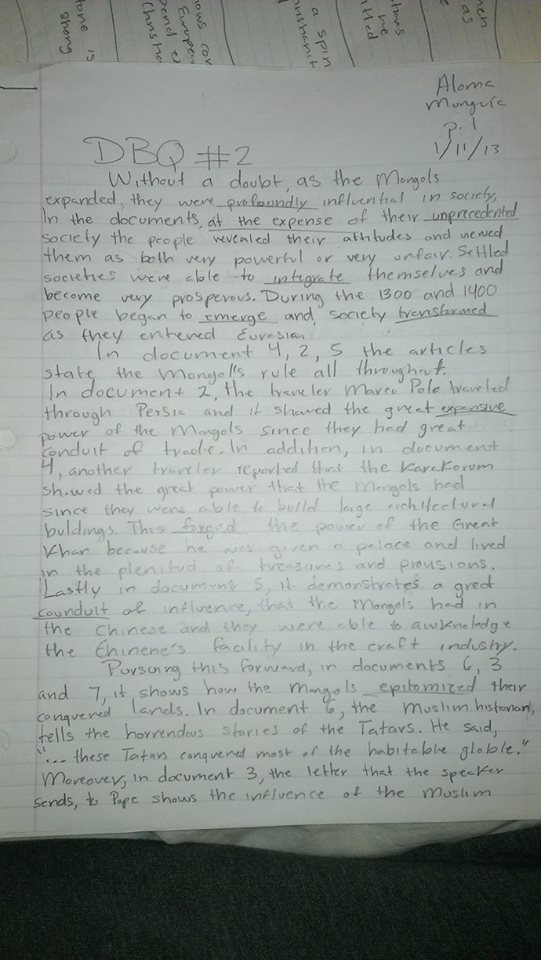
EvidenceThis shows evidence of a DBQ essay that I wrote of the Mongols. Beginning with the topic sentence, then evidence/examples and elaboration. I tried my best to write them as clear as possible, in order for the reader to understand the order and sequence of the essay.
HTS 2 : Chronological ReasoningReflectionWithout a doubt, periodization became a primordial skill in our AP World History class because we were able to divide six different time periods and have a better glimpse into each historical time period. I mostly struggled with this particular skill because there were so many important dates to remember, that I often confused them. However, creating timelines in the after school and Saturday sessions really helped me understand the material. As well as the Chinese Dynasty Song, that allowed me to connect each historical event with its correct periodization. As I memorized the song I was able to remember different events that were taking place across the world. For example, when it came to the AP Exam I was able to remember when the Mongols played a very important role in history, as well as the rise and the fall of various empires and dynasties (Gupta, Roman, Achaemenid, etc.) These basic tools became very useful throughout the year when we were asked to write Change Over Time essays, that were only between a certain period. We not only needed to state the important dates, but also explain its cause and effect, and extend on how one event contributed to a dramatic transformation later on. Evidence
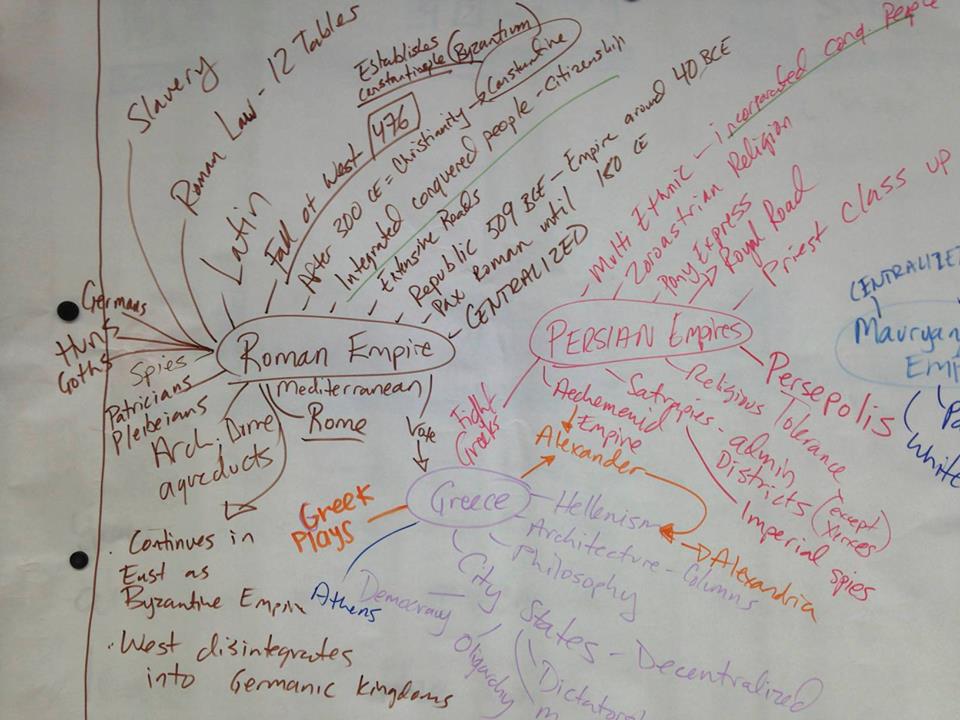
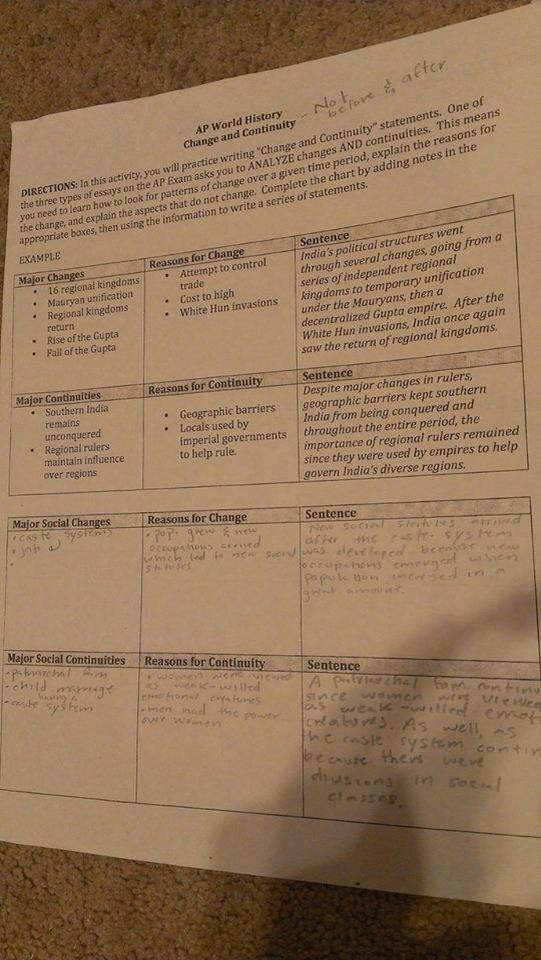
This is evidence, that shows a glimpse of a type of timeline that we created, during our afterschool study sessions that we were able to connect different historical events and place them in their correct periodization and write down their most important contributions and accomplishments. As well as the bottom picture that reflects my ability to explain its cause and effect for a change.
HTS 3 : Comparison and ContextualizationReflectionIn addition, another major skill that I was able to successfully fulfill was to correctly compare and contrast different types of context. Mr. Rodriguez, taught us how to use critical thinking and tie one basic concept that takes place in one place of the world with another. This allows us, as students to have a better understanding of the chronological order and memorize everything in its sequence. Utilizing this skill of comparison, we can then fill in our SPICE chart with as much information as possible. By using this format i was able to correctly compare two regions and explain their similarities and differences. For example, early civilizations of China and Mesopotamia in the 500 B.C.E, although they both strongly emphasized agriculture, their geographic location influenced the way they lived and the cultures their practiced. Without a doubt, in every essay of mine I would always look back into this chart because it provided me with the basic concepts and terms of history(social, political, interaction with the environment, culture and the economy). By simply remembering this concept I was able to score as many possible points because in my essays I not only stated the event, but I gave specific examples. For instance, in the comparison essay of WWI and WWII, where I analyzed both and explain the impact that they had because they cause not only implications socially, but also economically because the focus was into the complete and total war, and often forgot about the trading posts that they had to maintain. Evidence
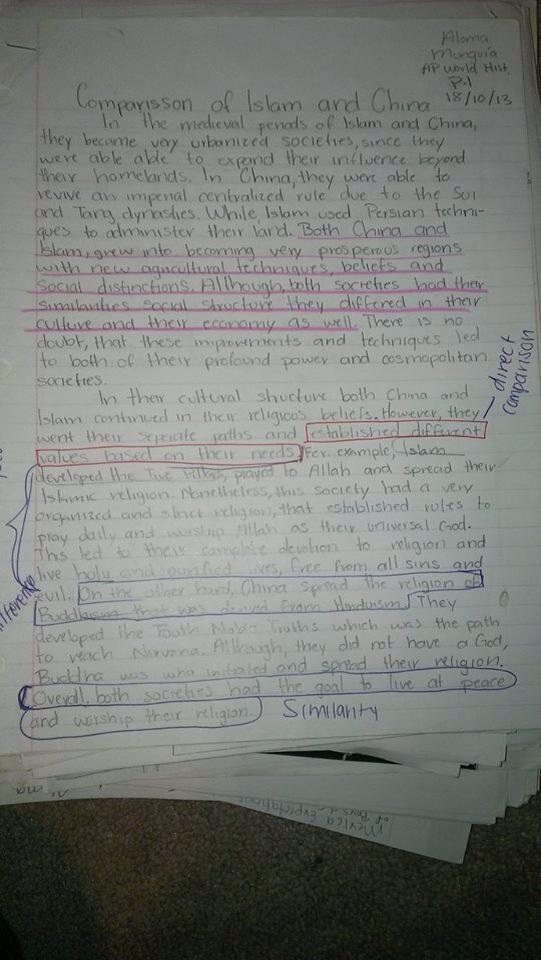
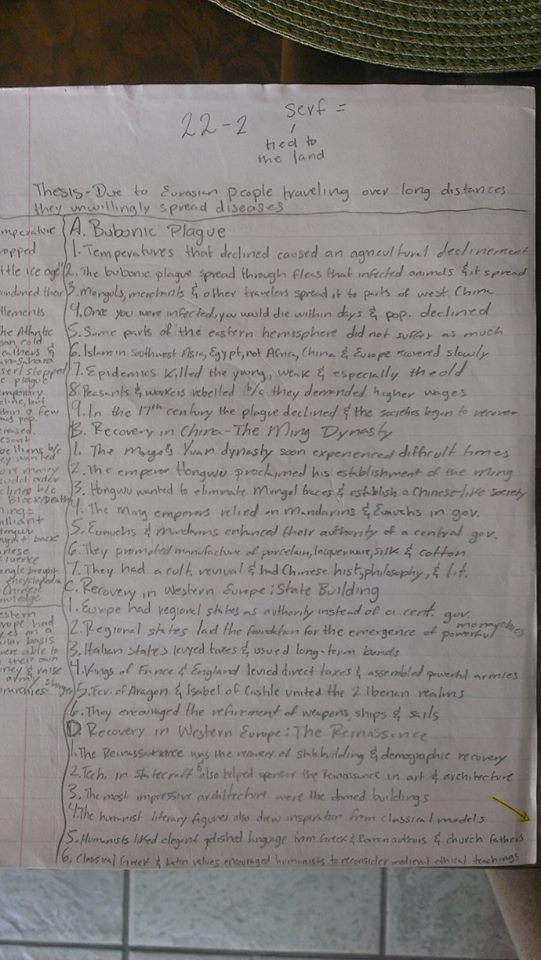
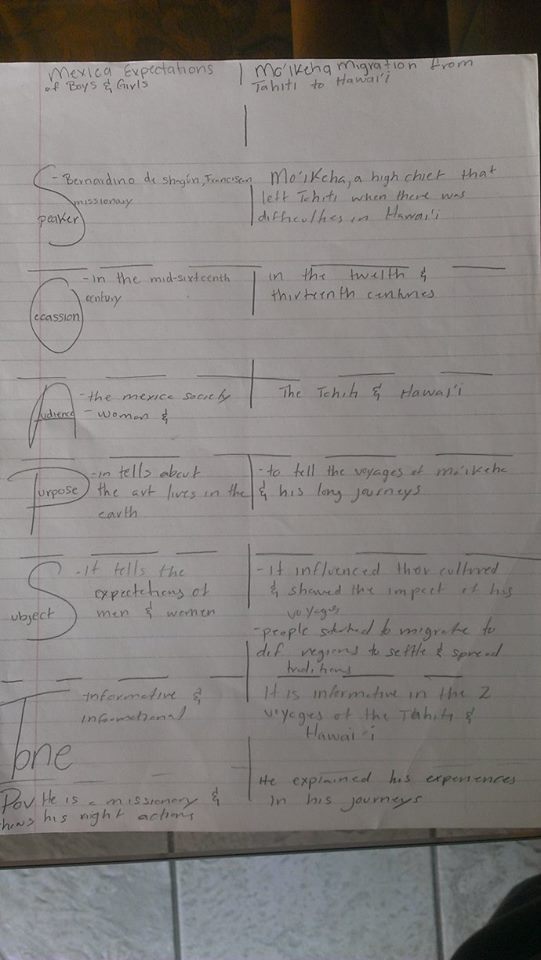
This shows an example of a comparison essay that I had comparing Islam and China and through this i was able to highlight, circle and underline important claims that I pointed out with the SPICE format. HTS 4: Historical Interpretation and SynthethisReflectionThis skill that I have learned, has become very beneficial because by annotating documents and historical context from our history book I have been able to instead of memorizing everything I have been able to understand and explain it. Mr. Rodriguez gave us various techniques; for example, SOAPSTONE that helped us analyze documents and break down each section of the document. This method became vey useful, for the AP Exam, because after so much practice throughout the school year I was able to quickly glance at the given information and already have an idea of what the prompt is about. As I would read I would often remind myself of these terms, and nonetheless it is was helped me analyze the author's claim and arguments. Interpreting sources from the past was not an easy task, but the SOAPSTONE format I was able to follow it and for the DBQ's I was successfully able to answer the prompts because of my organization and development of ideas. Moreover, synthesis notes also became very useful because they would help me breakdown the chapters and it would force me to read every section. I am confident that I will continue to use this note taking strategy throughout my currier as a student because it is not only helpful in history, but in any other subject. Although, notes did require many hours of your time, when it came down to the tests and quizzes I would remember my synthesis of the sections, which helped me earn a good grade. Evidence
Both of these images demonstrate my ability in note-taking skills and gives evidence of my knowledge in interpreting documents through a Soapstone format, which allowed me to become an active writer and provide clearer evidence in any essay.
|